What Does a Life Coach Do? | The Coaching Guild
Simply put, a life coach helps facilitate change, and that might be more complex than it sounds.
By Lisa M. Hayes for The Coaching Guild
If you are curious about becoming a coach, choosing a training program, or hiring a coach yourself, one of the most useful questions you can ask is this: what does a life coach actually do?
It sounds simple, but the answer matters.
The coaching industry is full of vague promises. Coaches are often described as transformational, empowering, intuitive, or life-changing. Those words may sound compelling, but they do not tell you much about the actual work. They do not explain what a coach does in a real conversation, what coaching is for, or what coaching should and should not include.
A clearer answer is this: a life coach helps people think more clearly, choose more honestly, and move forward with greater intention. A coach can help a client clarify goals, identify obstacles, strengthen self-awareness, change patterns, build accountability, and take meaningful action. Current consumer-facing coaching guidance from BetterUp describes life coaches in similarly practical terms, as partners who help clients clarify goals, overcome obstacles, and design action plans for change.
A life coach helps people clarify what they actually want
Many people come to coaching because they are stuck, overwhelmed, or disconnected from what matters to them. They may know they want change, but not know what kind. They may be capable and intelligent, but still unable to get clear on what comes next.
A life coach helps bring that into focus.
That does not mean handing the client answers. It means asking better questions, listening carefully, noticing patterns, and helping the client sort signal from noise. Coaching is often less about telling people what to do and more about helping them hear themselves more clearly.
A life coach helps people make decisions and move forward
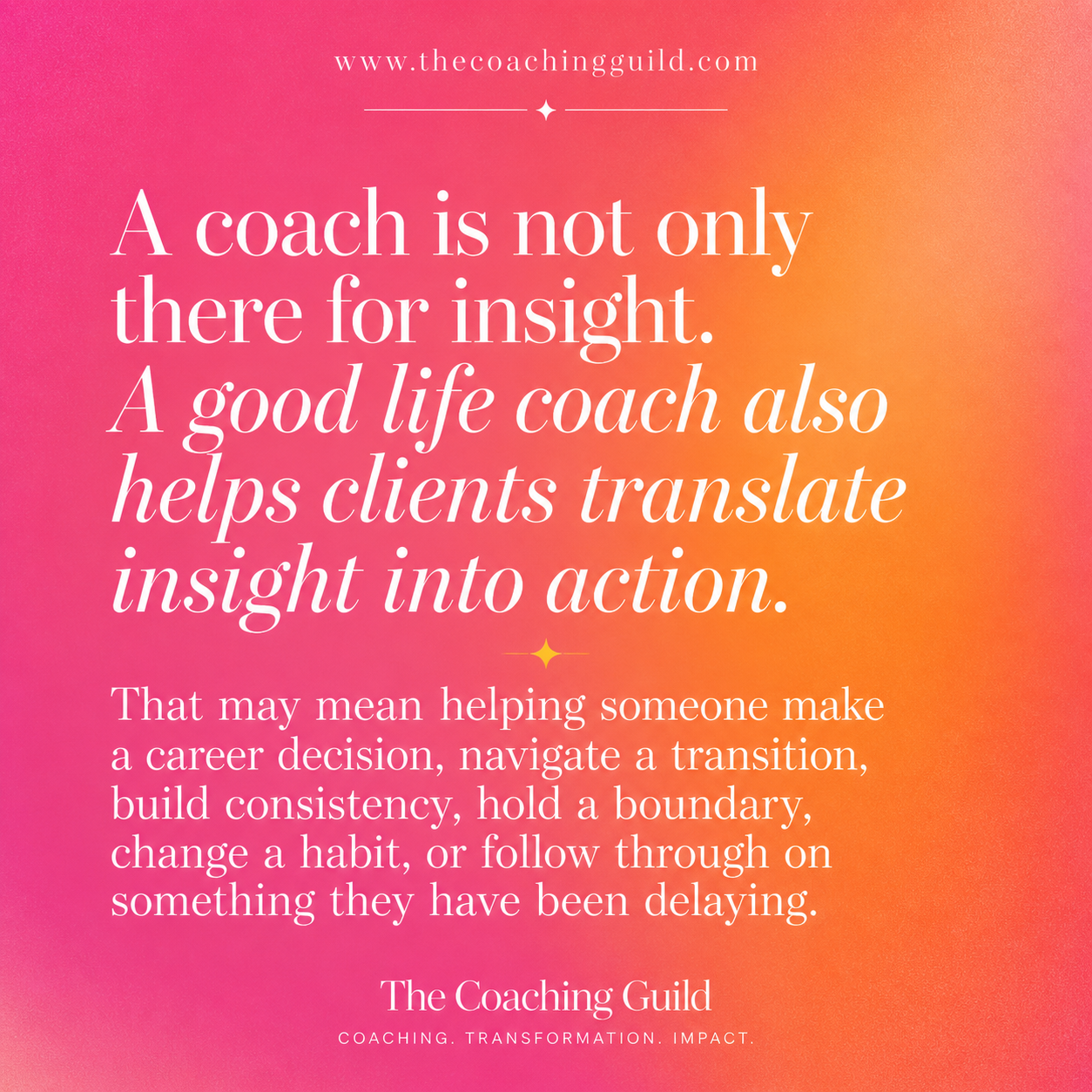
A coach is not only there for insight. A good life coach also helps clients translate insight into action.
That may mean helping someone make a career decision, navigate a transition, build consistency, hold a boundary, change a habit, or follow through on something they have been delaying.
The practical side of coaching is part of why coaching is often described as forward-focused. ICF describes coaching as a thought-provoking and creative process designed to help clients maximize their personal and professional potential.
In other words, life coaching is not only about talking. It is about movement.
A life coach helps clients build self-awareness
A lot of coaching work involves helping clients notice what is already happening.
What assumptions are driving their choices?
What fears keep repeating?
What old roles, loyalties, habits, or internal narratives are shaping the present?
What values are clear, and where are they out of alignment?
This kind of self-awareness can be powerful. It can help clients stop repeating patterns automatically and start choosing more consciously. Coaching can create space for honesty, reflection, and more intentional decision-making.
A life coach helps with accountability
This is one of the most recognizable parts of coaching, and one of the most misunderstood.
Accountability in coaching is not supposed to mean pressure, performance, or external control. At its best, it means helping a client stay connected to what they said mattered. A coach can help clients identify next steps, notice where they are hesitating, and stay in relationship with their own commitments.
That kind of support can be especially useful when someone is trying to make a change that matters to them but keeps getting crowded out by fear, confusion, or habit.
A life coach does not do therapy
This is one of the most important distinctions in the field.
A life coach can work with emotion, patterns, values, goals, and change. A life coach is not a therapist unless they are separately trained and licensed as one and are explicitly working in that role. APA describes psychotherapy as a psychological service used to assess and treat mental and emotional concerns, while ICF’s ethics and guidance stress that coaches must understand scope and refer out when a client needs support beyond coaching.
That means a life coach is not there to diagnose mental illness, provide clinical treatment, or blur professional boundaries in the name of depth.
Good coaching can be deep.
Depth is not the same thing as therapy.
A life coach should work within clear ethical boundaries
A serious life coach should understand scope, boundaries, and ethics.
That includes knowing what coaching is for, what it is not for, and when referral is necessary. ICF treats ethical practice as foundational to coaching, and its current ethics materials place “Demonstrates Ethical Practice” first among the core coaching competencies.
This matters because the coaching relationship can involve trust, vulnerability, hope, and influence. A coach should know how to work responsibly with that. Ethical coaching is not an optional upgrade. It is part of what makes coaching professional in the first place.
What a life coach does in a real session
In practice, a life coach may do things like:
help a client clarify the focus of the conversation
ask questions that uncover assumptions, patterns, or values
reflect back what they are hearing
notice contradictions or blind spots
help the client identify options
support more honest decision-making
help turn insight into next steps
track commitments and follow-through over time
That is a much more grounded picture than the vague idea that a life coach is simply someone who motivates people.
What a life coach is not there to do
A life coach is not there to become the expert on your life.
A life coach is not there to create dependency.
A life coach is not there to dominate your choices, inflate their own authority, or substitute charisma for skill.
A life coach is not there to perform transformation as a brand aesthetic.
The role of a coach is not to become the center of gravity. The role of a coach is to help the client become more self-aware, more self-led, and more able to move through life with intention.
Why this matters for future coaches
If you want to become a coach, this question matters because it tells you what your training should actually prepare you to do.
A strong coach training program should not just teach you to sound inspiring. It should teach you how to listen, ask better questions, hold ethical boundaries, recognize scope, support action, and work responsibly with real people in real complexity. ICF’s education guidance likewise tells prospective coaches to choose training that aligns with core coaching competencies and ethical guidelines.
That is a different standard from branding alone.
Where The Coaching Guild stands
At The Coaching Guild, we believe life coaching should be grounded in rigor, ethics, discernment, and real skill. We believe serious coach training should prepare people for real-world coaching, not just aspirational branding. Our faculty page explicitly positions The Coaching Guild as a multi-instructor institution committed to rigorous, ethical, real-world preparation.
A life coach should know how to help people think more clearly, choose more honestly, and move forward in meaningful ways.
A coach should also know the limits of the role.
That is part of what makes the work credible.
Final answer: what does a life coach actually do?
A life coach helps people create change.
Not by becoming the authority on their life, and not by pretending to be a therapist, but by helping them gain clarity, build self-awareness, make decisions, follow through, and move toward a life that fits more honestly.
That is the work.
And done well, it matters.