Coaching vs Mentoring vs Consulting: What’s the Difference?
A Serious Case of Similar but Different
By Lisa M. Hayes for The Coaching Guild
If you are trying to choose support for your growth, your work, or your next season of change, one of the most useful questions you can ask is not, “Who seems the most impressive?” It is, “What kind of help do I actually need?”
This is where people get confused.
Coaching, mentoring, and consulting are often treated like they are interchangeable. They are not. All three can be valuable. All three can help someone move forward. But they do different jobs, and choosing the wrong one can leave people frustrated, over-dependent, or disappointed by a process that was never designed for what they actually needed.
A clearer understanding helps.
What coaching is
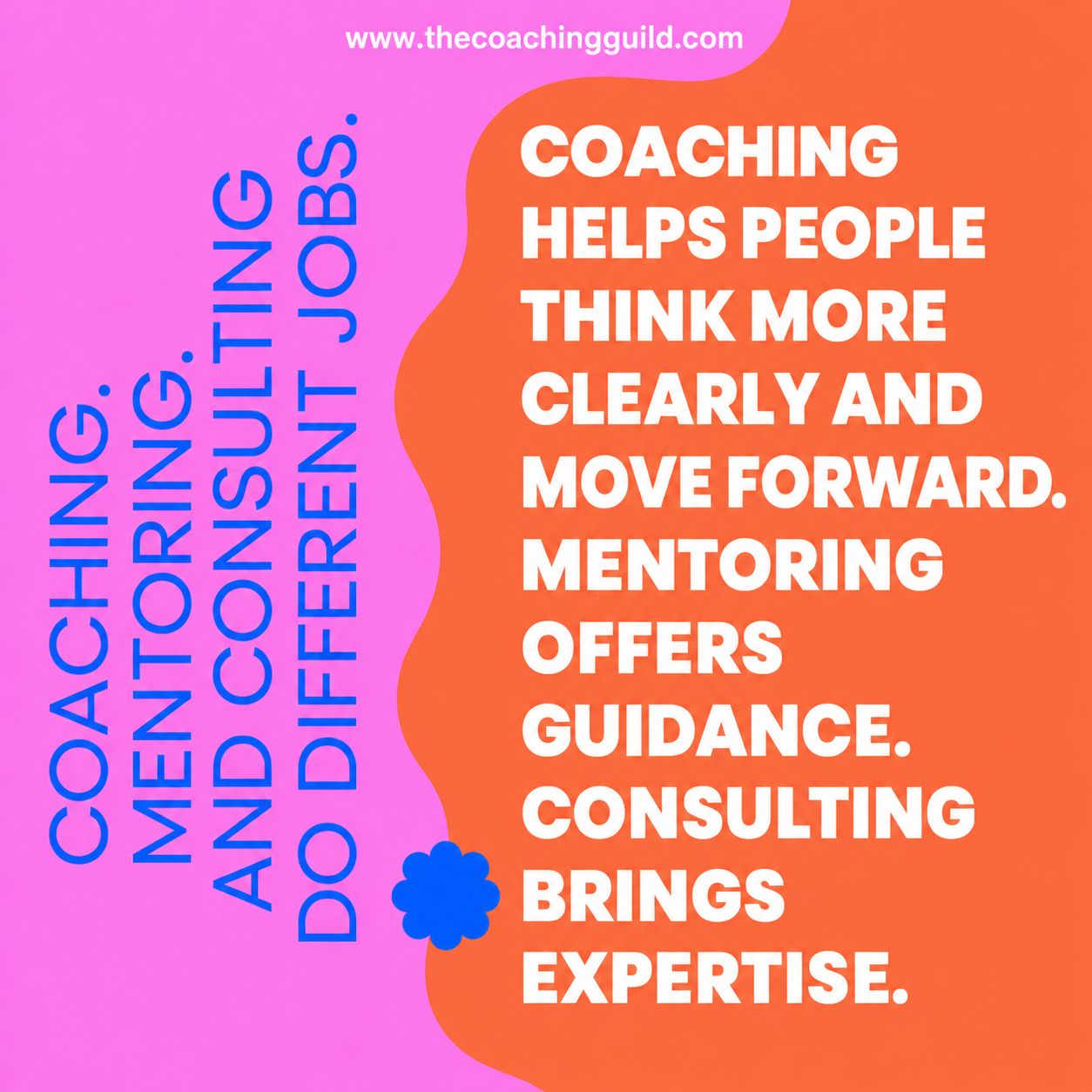
Coaching is generally designed to help someone think more clearly, make better decisions, deepen self-awareness, and move forward through reflection, inquiry, and accountability. Cornell’s career guidance describes coaching as a process that helps people uncover their own answers and move forward through guided reflection and inquiry. The Open University similarly notes that coaching helps individuals take responsibility for and manage their own learning and development.
In practice, that means a coach is not primarily there to tell you what to do. A coach is there to help you think, notice, decide, and act with more honesty and intention.
A coach may help you:
- clarify what you want
- identify patterns or blind spots
- make a difficult decision
- build consistency
- follow through on something that matters
- strengthen self-trust and accountability
Good coaching is not advice in better packaging. It is a distinct process built around helping the client become more self-aware and more self-led.
What mentoring is
A mentor usually brings personal experience, field knowledge, or career wisdom more directly into the relationship. The Open University notes that mentoring involves additional skills related to guiding, career support, and networking. Kent State’s guidance also distinguishes mentoring from coaching by emphasizing that mentoring is more likely to include advice, perspective, and direction based on lived experience.
A mentor may say:
- Here is what I learned when I faced something similar.
- Here is what I would watch for.
- Here is how this industry works.
- Here is what helped me.
- Here is someone you should know.
If you need perspective from someone who has walked a road before you, mentoring may be the right fit. Mentoring is often especially helpful when someone needs wisdom, context, encouragement, professional perspective, or a model from a more experienced person.
What consulting is
Consulting is different from both coaching and mentoring.
A consultant is typically hired for expertise. Furman University describes coaching and consulting as different points on a professional-development continuum, and other recent explainers summarize the distinction clearly: coaching helps draw answers out of the client, while consulting is more likely to tell the client what to do or what to implement.
A consultant may say:
- Here is the problem I see.
- Here is the strategy I recommend.
- Here is how I would structure this.
- Here is the system you need.
- Here is the plan.
That is useful when you need subject-matter expertise, diagnosis, strategy, or direct recommendations. If you need someone to assess a situation and bring answers, consulting may be the right form of support.
Why people confuse them
People confuse coaching, mentoring, and consulting because all three involve conversation, development, and forward movement. On the surface, they can look similar. Growth Space’s recent guide makes exactly this point: all three involve external support, but they work in very different ways and serve different needs.
The confusion gets worse when practitioners blur the lines.
Some coaches mentor without naming it. Some consultants call everything coaching because the word sounds warmer. Some mentors slide into coaching language while mostly offering direction. None of that is automatically wrong, but it should be clear.
Clients deserve to know what kind of support they are actually receiving.
When coaching is the right fit
Coaching is often the right fit when the person does not need someone else’s answers as much as they need space, structure, and skillful inquiry to find their own.
Coaching tends to work well when someone:
- is facing a decision but needs clarity
- wants to change a habit or pattern
- is trying to move through a transition
- wants accountability around a goal
- needs help thinking more honestly
- wants support without being told who to be
This is one reason coaching can be so powerful. It does not assume the client is empty and needs to be filled with expertise. It assumes the client has intelligence, agency, and capacity, and needs the kind of partnership that helps those qualities come forward. Cornell’s explanation reflects this same idea by describing coaching as a guided process for uncovering one’s own answers.
When mentoring is the right fit
Mentoring is often the right fit when someone needs lived wisdom, field-specific perspective, or guidance from a person who has already navigated a similar road.
Mentoring can be especially useful when someone:
- is entering a new profession
- needs career guidance
- wants perspective from experience
- needs industry context or informal navigation help
- would benefit from encouragement grounded in real-world lessons
A mentor may help someone avoid unnecessary mistakes, expand their view of what is possible, or feel less alone in a learning curve. That is not the same as coaching. It is more directional, more experience-based, and often more advisory.
When consulting is the right fit
Consulting is often the right fit when the client needs expertise more than reflection.
If a business needs a strategy, a team needs a process, or a leader needs a specific solution from someone with deep knowledge, consulting may be the most efficient and appropriate support.
Consulting is often right when someone needs:
- expert diagnosis
- strategic recommendations
- implementation guidance
- a framework or system
- specialized knowledge they do not already have
That does not make consulting less valuable than coaching. It simply means it serves a different function. The mistake is not choosing consulting. The mistake is hiring a consultant when you need coaching, or hiring a coach when what you really need is expertise.
What ethical practitioners do
Strong practitioners know the difference.
They know when they are coaching and when they are advising. They know when they are mentoring and when they are consulting. They do not hide the method. They do not pretend every form of support is coaching just because coaching is a fashionable label.
This matters because clarity protects trust.
If someone hires a coach, they should not quietly find themselves in a consulting relationship. If someone wants mentorship, they should not be sold a purely non-directive process and then feel disappointed that no one is offering perspective. If someone needs expertise, they should not be told to keep “finding their own answers” when what they really need is informed guidance.
The more honest the distinction, the cleaner the work.
What future coaches should understand
This question matters for future coaches too.
A serious coach training program should help people understand what coaching is, what it is not, and how it differs from other kinds of support. It should help students learn how to stay in a coaching role without becoming shallow, vague, or artificially hands-off. It should also help them recognize when a mentoring or consulting move is happening and how to name that clearly if their work includes multiple functions.
That kind of clarity is part of ethical practice.
It is also part of becoming credible.
Where The Coaching Guild stands
At The Coaching Guild, we believe serious coach training should prepare people for real-world coaching, not just aspirational branding. That includes teaching future coaches what coaching actually is and how it differs from mentoring and consulting.
Coaching is not just a warm word for helping.
It is a distinct discipline.
A coach is not there primarily to become the expert on the client’s life, hand down wisdom from above, or prescribe solutions. A coach is there to help clients think more clearly, choose more honestly, and move forward with greater intention.
Final answer
Coaching helps people uncover their own answers and move forward through reflection, inquiry, and accountability.
Mentoring brings more personal experience, guidance, and perspective.
Consulting brings expertise, strategy, and recommendations.
All three can be valuable.
The real question is not which one sounds best.
The real question is which one fits the work that needs to be done.