How to Know if You’re Being Trained to Be a Replica Coach
Coach training should make you more of who you are.
By: Lisa M. Hayes
If you are in a coach training program, one of the most important questions you can ask is not only whether you are learning.
It is whether you are becoming more yourself, more skillful, more discerning, and more capable of thinking clearly.
Or whether you are slowly being trained to become a replica.
This matters because not all coach training is really education. Some of it is imitation with a curriculum. Some of it is organized around one central personality, one central worldview, one central emotional style, and one central definition of what counts as wisdom, transformation, or authority.
In those spaces, students may believe they are being trained as coaches when they are actually being shaped into better copies of the person at the center.
That is not the same thing.
I am not interested in training replica coaches, and I think future coaches need to get much better at spotting the difference.
A replica training program creates sameness
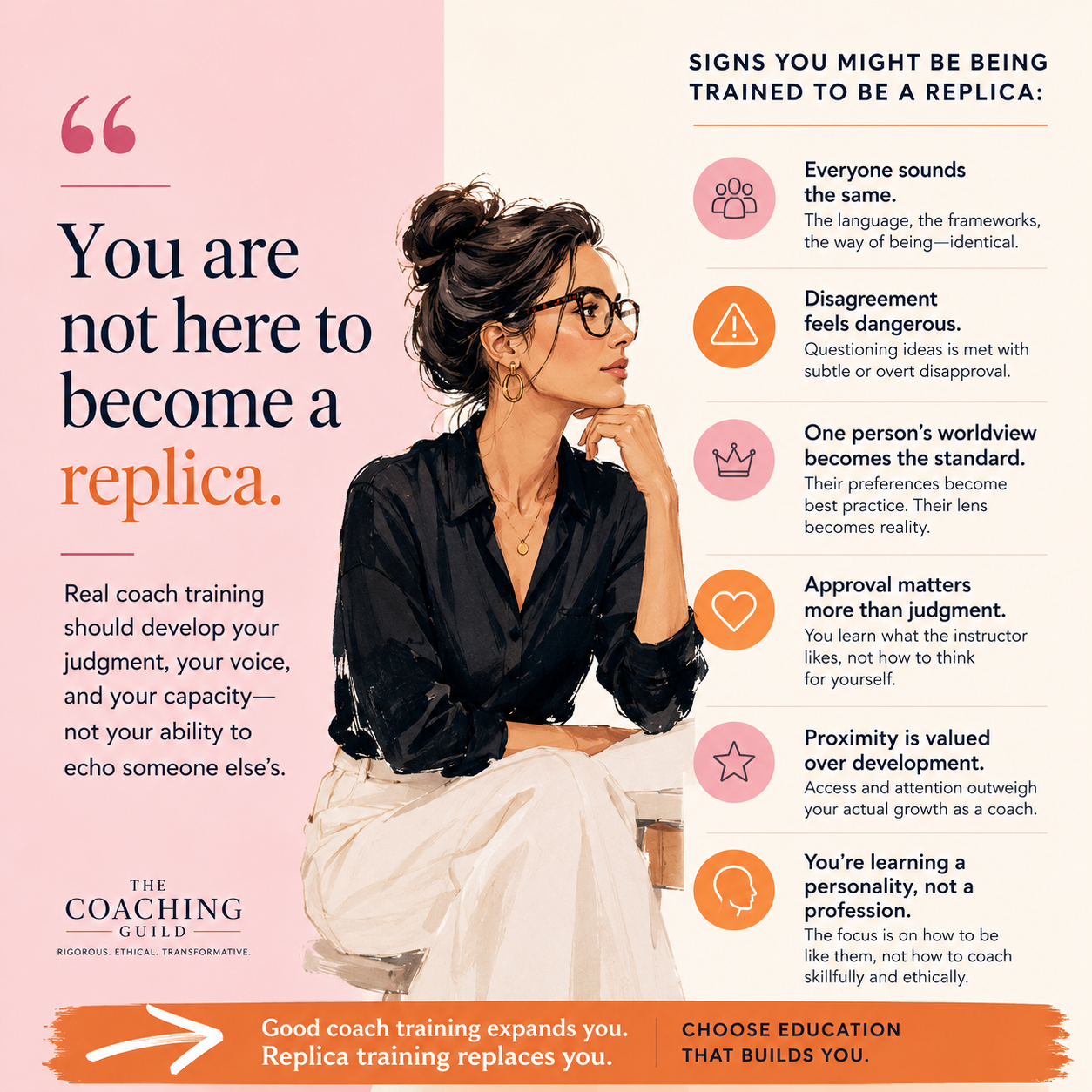
One of the clearest signs you are being trained to be a replica is that everyone starts sounding strangely alike.
The same language shows up everywhere. The same phrases get repeated. The same social post cadence appears. The same emotional posture gets rewarded. The same ideas about power, healing, leadership, and transformation start circulating as if they are settled truth rather than one person’s interpretive lens.
Over time, the room starts to feel less like a place where people are learning to think and more like a place where people are learning to echo.
That is not a small problem.
A serious coach training program should help students become more precise and more skillful, but it should not erase range. It should not flatten people into a single branded personality type. It should not turn adult learners into coordinated descendants of a founder.
If everyone coming out of a program sounds like they came from the same mouth, I would pay attention.
Disagreement starts to feel dangerous
Another sign you are being trained to be a replica is that disagreement begins to feel like disloyalty.
In healthy education, students are allowed to think. They are allowed to question. They are allowed to wrestle with ideas, test frameworks, and develop their own judgment.
In unhealthy training cultures, especially ones built around one powerful central figure, disagreement quietly starts to carry a social cost.
Students learn what gets approval.
They learn what gets rewarded.
They learn which ideas are safe to repeat and which questions create tension.
Eventually, many stop asking real questions and begin performing alignment.
That is not discernment. That is adaptation.
A good coach training program should sharpen your mind, not teach you to abandon it in exchange for belonging.
The founder becomes the hidden standard for reality
Replica training happens when one person’s worldview stops being a contribution and becomes the atmosphere.
Suddenly, the founder’s preferences become best practice. The founder’s blind spots become invisible. The founder’s communication style becomes the model. The founder’s emotional habits become normal. The founder’s way of reading clients becomes the standard by which other ways of seeing are measured.
That is too much unchecked influence for one person to have.
No matter how gifted, experienced, insightful, or charismatic an instructor may be, no single human being should function as the sole interpreter of what coaching is and what a future coach should become.
Future coaches deserve more range than that.
They deserve more than one nervous system in the room.
They deserve more than one way of thinking.
They deserve more than one model of seriousness, ethics, and responsibility.
You are being shaped for approval, not for judgment
A replica program does not really train judgment. It trains approval-seeking.
Students start organizing themselves around what the instructor likes. They unconsciously learn how to sound right, how to mirror the values in the room, how to echo the preferred talking points, and how to position themselves as good students inside the internal culture.
This may look like success from the outside.
It is not the same thing as becoming a trustworthy coach.
A trustworthy coach needs judgment. A trustworthy coach needs discernment. A trustworthy coach needs the ability to sit with complexity without reflexively reaching for the founder’s script. A trustworthy coach needs to be able to think in real time, not merely perform ideological loyalty in the right vocabulary.
If your training is making you more dependent on external approval and less able to trust your own developing judgment, I would take that seriously.
Technique matters less than proximity
One of the more subtle warning signs is that the culture starts revolving around closeness to the founder more than the actual development of the student.
People become preoccupied with access, attention, recognition, and emotional proximity. Being seen by the central figure starts to feel more important than becoming more skillful. The social gravity of the room shifts away from practice, ethics, and real formation and toward the politics of belonging.
That kind of environment can feel intimate, intense, and meaningful.
It can also become profoundly distorting.
Education should not revolve around orbit.
A coach training school should not be a solar system built around one person’s glow.
The center of gravity should be the formation of the student, not the mythology of the instructor.
You are learning a personality more than a profession
This is another way replica training reveals itself.
You stop learning the discipline of coaching and start learning a persona. You learn how to sound wise. You learn how to hold yourself in a certain way. You learn how to signal depth. You learn how to market a certain identity. You learn the emotional aesthetics of the room.
But you do not necessarily become better at listening, boundaries, discernment, ethical responsibility, or working with real human complexity.
That is a dangerous trade.
The coaching industry already has plenty of people who know how to look the part. It does not need more people trained in personality management while calling it transformation.
A real training should form practitioners, not replicas.
Healthy coach training expands you
Good coach training should make you more skillful, yes. It should also make you more mentally alive.
It should expand your capacity to think.
It should deepen your ethics.
It should sharpen your discernment.
It should strengthen your ability to listen and respond responsibly.
It should help you become more fully yourself in the work, not less. Not louder in borrowed language. Not more marketable in someone else’s image. More grounded in your own mind, your own integrity, and your own developing capacity.
That is what actual education does.
It does not collapse people into sameness. It gives them structure, challenge, perspective, and responsibility so that their own judgment can mature.
Why multi-instructor learning matters
This is one of the reasons I care so much about multi-instructor training.
A multi-instructor environment does not automatically make a program ethical, but it does make replica culture much harder to sustain. It introduces range. It creates friction. It offers students more than one model of presence, more than one teaching style, more than one way of working with human complexity.
Students should not be formed inside a closed loop.
They should be exposed to perspective.
They should see that strong coaching does not only come in one voice, one body, one temperament, or one worldview.
That kind of range helps people grow their own judgment instead of outsourcing it to a single personality.
Where The Coaching Guild stands
At The Coaching Guild, I am not interested in training replica coaches.
I am not interested in producing prettier copies of a founder. I am not interested in students learning how to sound polished in someone else’s dialect of certainty. I am not interested in building a school where everyone learns to echo the same worldview and call that mastery.
I am interested in training coaches who can think.
I am interested in training coaches with real ethics, real discernment, and real capacity. I am interested in people becoming more trustworthy, more skillful, more grounded, and more fully themselves in the work.
That is one of the reasons The Coaching Guild is built as a multi-instructor school. Students deserve range. They deserve perspective. They deserve more than one lens on what thoughtful, responsible coaching can look like.
Most of all, they deserve a training that strengthens their own mind rather than rewarding their willingness to disappear into somebody else’s.
Final answer
So how do you know if you are being trained to be a replica?
If everyone sounds the same, if disagreement feels dangerous, if one person’s worldview becomes the whole atmosphere, if approval matters more than judgment, if proximity matters more than formation, and if you are learning a personality more than a profession, I would pay attention.
Real coach training should not turn you into a copy.
It should help you become a coach.