What Makes Coach Training Ethical?
Guru culture is so 2010

By: Lisa M. Hayes for The Coaching Guild
If you are looking for a coach training program, the better question is not whether it sounds inspiring. The better question is whether it is ethical.
That matters because coach training is not neutral. It does not only teach technique. It teaches worldview. It teaches power. It teaches what gets normalized, what gets rewarded, what gets named as transformation, and what gets ignored. A coach training program is not just passing along information. It is shaping people who will eventually sit with other human beings in positions of trust and influence.
That is why ethics are not decorative. Ethics are not a bonus module. Ethics are not a quick disclaimer tucked into the curriculum so nobody gets sued. Ethics are the structure that keeps coaching from becoming manipulation, projection, ego theater, or well-branded harm.
And one of the clearest ethical questions a future coach can ask is this: who is shaping me, and how much unchecked power does that person have inside this training?
Ethical coach training does not build around a single unchecked point of view
This is one of the dangers people do not talk about enough.
A single-instructor training program can be deeply appealing. It can feel intimate, coherent, magnetic, and highly personalized. It can also become a problem very quickly if one person’s worldview becomes the entire atmosphere of the training.
When one instructor becomes the sole source of truth, the sole standard, the sole lens, the sole model, and the sole interpreter of what good coaching is, students are not only learning coaching. They are being asked to absorb a full framework of reality from a single point of view.
That is risky.
No matter how talented, experienced, insightful, or charismatic one person may be, no single human being should have that much unchecked influence over the formation of future coaches.
A coach training program should not function like a personality cult with a workbook.
Single-instructor programs can confuse devotion with discernment
This is where things can get ethically thin.
When a training is built entirely around one central figure, students may begin to organize themselves around approval, imitation, and adaptation rather than discernment. They may start learning how to sound like the instructor instead of how to think like a coach. They may absorb the mannerisms, worldview, biases, blind spots, and emotional habits of one person and mistake that for professional development.
That is not the same thing as being well trained.
It is especially dangerous when the instructor is highly charismatic, highly certain, or strongly identified with being the smartest or most evolved person in the room. In those spaces, disagreement can start to feel like disloyalty, and students may quietly lose access to their own judgment in the name of learning.
That is not ethical formation.
That is overidentification.
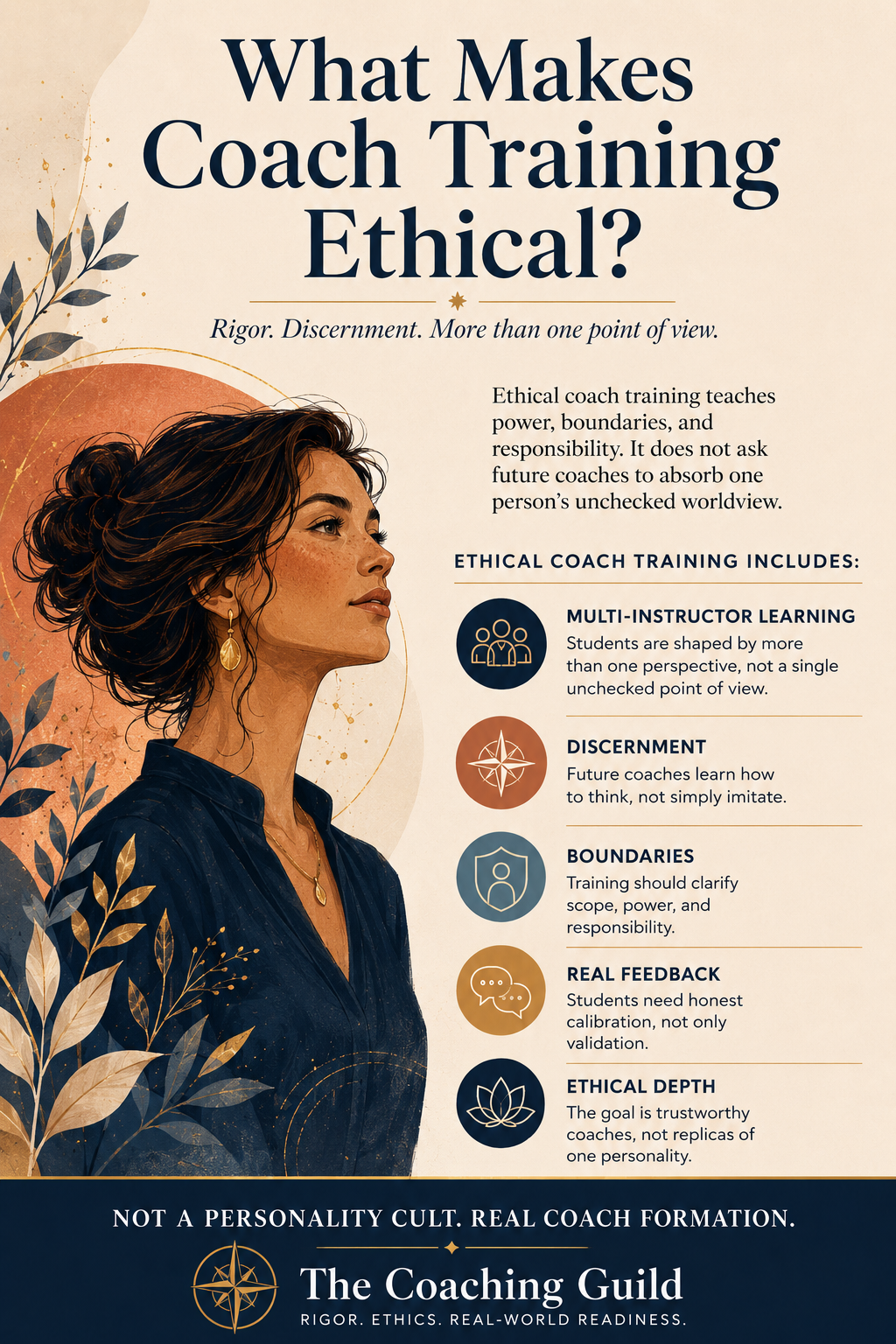
Ethical coach training should expose students to range
A serious coach training program should help students build skill, judgment, and discernment across real complexity.
That means students need range.
They need more than one nervous system in the room.
They need more than one teaching style.
They need more than one way of seeing human behavior.
They need more than one model of presence, challenge, ethics, and responsibility.
A multi-instructor environment does not guarantee ethical excellence, but it does create a healthier structure for it. It allows for more perspective, more nuance, more tension, more calibration, and more reality-testing. It makes it harder for one person’s blind spots to become the entire architecture of the program.
That matters, especially in a field where so much can be hidden behind confidence and branding.
Ethical coach training teaches power, not just technique
Coaching is not only a set of conversational tools. It is a power dynamic.
The moment one person is trusted to help another with change, clarity, pain, growth, direction, or becoming, power is already present. A serious coach training program should teach that clearly.
Future coaches should understand influence, authority, suggestion, dependence, boundaries, projection, and the subtle ways ego can enter the work. They should be taught that warm intentions are not enough. They should be taught that charisma is not ethics. They should be taught that being admired is not the same thing as being trustworthy.
An ethical program teaches students how to notice where power lives and how to hold it responsibly.
It does not simply teach them how to look confident while holding it.
Ethical coach training teaches boundaries
A lot of bad coaching begins with blur.
Blurred roles.
Blurred scope.
Blurred authority.
Blurred accountability.
Blurred responsibility.
An ethical coach training program should teach future coaches how to know what the work is, what the work is not, and where their role begins and ends. It should teach the difference between coaching and rescuing, coaching and controlling, coaching and over-identifying, coaching and becoming emotionally central in a client’s life.
If a program talks constantly about transformation but rarely talks about boundaries, that is not sophistication. That is a red flag.
Ethical coach training teaches discernment, not imitation
It should produce coaches who can think.
Discernment matters more than mimicry. Real training should help students read what is happening in the room, tolerate complexity, recognize what kind of intervention is actually called for, and know when not to push, not to inflate, and not to make themselves more important than the work.
That takes more than scripts.
That takes more than methods.
That takes more than brand language.
That takes judgment.
And judgment develops better in spaces where students are not being unconsciously trained to mirror one person’s identity.
Ethical coach training includes real feedback
Programs that only validate students are not doing them any favors.
If someone is going to coach real human beings, they need more than encouragement. They need feedback. They need to know where they are collapsing into advice, where they are over-talking, where they are leading too hard, where they are avoiding discomfort, where they are projecting, and where their own unresolved material is leaking into the work.
Ethical coach training should sharpen people.
It should not only bless them.
And feedback becomes healthier when it is not filtered through a single personality at the top of the hierarchy. Multiple instructors create more room for perspective, calibration, and reality. That is not only pedagogically useful. It is ethically useful.
Ethical coach training prepares people for real-world coaching
A coach training program should not prepare students merely to perform confidence in coaching spaces. It should prepare them to coach.
That means real practice.
Real complexity.
Real ethical conversations.
Real standards.
Real responsibility.
The work should not revolve around proximity to the founder. It should revolve around the formation of the student.
That is a very different center of gravity.
Where The Coaching Guild stands
At The Coaching Guild, we believe ethical coach training should prepare people for real-world coaching, not just aspirational branding. We believe future coaches need rigor, boundaries, discernment, strong faculty, meaningful feedback, and actual skill development.
We also believe there is ethical value in multi-instructor training.
No one person should have unchecked influence over the formation of future coaches. Students deserve range. They deserve perspective. They deserve more than one model of thoughtfulness, presence, skill, and responsibility. They deserve a training environment that helps them become better coaches, not better replicas of a single personality.
That matters to us.
A lot.
Final answer
So what makes coach training ethical?
Not beautiful branding.
Not charisma.
Not certainty.
Not a single magnetic instructor with a devoted audience.
Ethical coach training teaches power, boundaries, discernment, responsibility, and real respect for human complexity. It creates enough perspective inside the training that students can grow their own judgment instead of outsourcing it to one person’s worldview.
It forms coaches who are not only effective.
It forms coaches who can be trusted.