Do You Need ICF Certification to Be a Coach?
If you're going to get your money from a corporation vs. an individual, the answer is maybe.
By: Lisa M Hayes for The Coaching Guild
One of the most common questions future coaches ask is whether they need ICF certification to become a coach. The honest answer is no. Coaching is not a field where a universal legal gate prevents someone from practicing, and ICF’s own credentialing materials are designed as a professional standard, not as proof that coaching is legally restricted to credentialed practitioners.
That matters, because the internet often turns this question into a kind of panic spiral. People start to believe they cannot coach unless they have the right acronym, the right badge, or the right institutional approval. That is simply not true.
The more useful answer is this: ICF certification mostly comes into play if you intend to pursue corporate-paid work, institutional contracts, or professional environments that use formal credentials as a screening mechanism. In those spaces, a credential may help you get through the door. It can function as shorthand for employers, procurement systems, or organizations that want an externally recognizable standard. ICF’s structure itself reflects that logic, with formal education, mentoring, logged hours, and performance evaluation designed to signal professional readiness.
If you work directly with human beings, however, the equation is often very different.
Private clients rarely ask whether a coach has an ICF credential. They want to know whether you are skilled, whether you are ethical, whether you can hold complexity, whether you listen well, and whether you can help them create real change. They want to know whether your work helps.
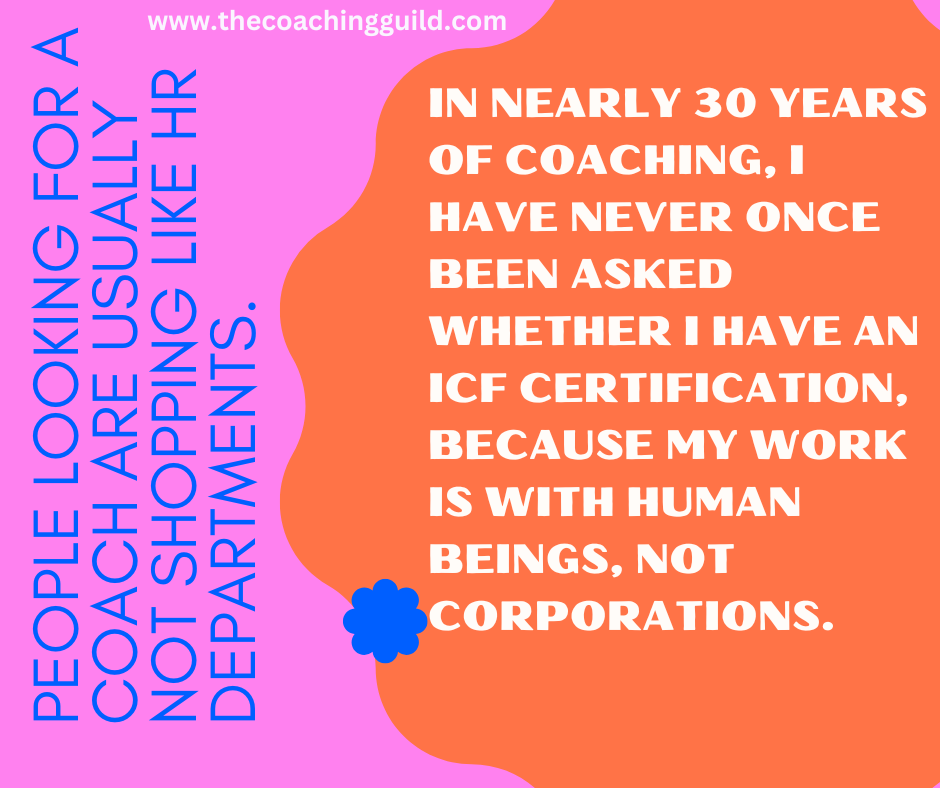
In nearly 30 years of coaching, I have never once been asked whether I have an ICF certification, because my work is with human beings, not corporations.
That does not mean standards do not matter. It means the standards that matter most are not always the ones people market the hardest.
A serious future coach should absolutely care about training. A serious future coach should absolutely care about ethics. A serious future coach should absolutely care about skill. Those things matter enormously. They just do not reduce neatly to a single credentialing conversation.
What ICF Certification Is Actually For
ICF credentialing has a purpose. It is useful for coaches who want to move through formal systems that recognize or prefer that framework. It can also be meaningful for coaches who personally want that structure, that pathway, or that external benchmark.
ICF’s credentialing process is built around defined thresholds of coach-specific education, coaching experience, mentor coaching, and assessment. That makes sense if your goal is to enter spaces that care about those markers. It also makes sense if you are the kind of person who wants a formalized route and a globally recognized professional association.
None of that means it is the only path to becoming a skilled coach. None of it means it is the primary thing private clients care about. None of it means it should be treated like the singular measure of whether someone is prepared to do meaningful coaching work.
The Real Question Is What Kind of Coach You Want to Be
This is where the conversation gets more interesting.
If you want to build a practice serving actual human beings in private work, community-based work, relational work, identity work, transformational work, or other direct client settings, the question is not primarily whether you have ICF certification.
The question is whether you can coach.
Can you listen beyond performance?
Can you recognize what is actually happening in the room?
Can you hold complexity without collapsing into advice, fixing, or projection?
Can you work ethically?
Can you help someone move toward a more honest, more self-led, more meaningful life?
Those are the questions that matter in real coaching relationships.
People looking for a coach are usually not shopping like HR departments. They are not doing vendor compliance. They are trying to figure out whether they trust you, whether your work is credible, and whether you can actually help them. That is a different kind of threshold.
Weak Training Is a Bigger Problem
Many future coaches spend too much time worrying about whether they need a certification and not nearly enough time worrying about whether their training is shallow.
That is the real danger.
There are plenty of people in this field who know how to market themselves and very little about how to coach. There are plenty of people who can speak the language of transformation without having the depth, ethics, or discernment to do the work well. There are plenty of programs that are better at producing excitement than competence.
A credential cannot fix weak training.
A badge cannot substitute for judgment.
A marketing identity cannot replace practice.
If you are serious about becoming a coach, you need education that develops your actual capacity. You need training that includes structure, feedback, ethical rigor, real practice, and enough complexity to prepare you for human beings as they actually are, not as they appear in a sales page fantasy.
What to Look For Instead of Getting Stuck in Confusion
If you are trying to choose a coach training program, start here;
Look for a program with a real ethical spine. Coaching places you in relationship with people’s lives, vulnerabilities, and decision-making. Ethics are not decorative. They are foundational.
Look for substantial practice. You do not become a coach by consuming content. You become a coach by practicing, receiving feedback, refining your judgment, and learning how to work in real conditions.
Look for depth in the faculty and curriculum. A serious program should be able to hold complexity. It should help you become more skillful, not just more coach-coded.
Look for a training environment that respects the reality of how different coaches will work.
Some people want corporate contracts. Some want private practice. Some are already seasoned practitioners in adjacent fields and want to deepen or expand their functional coaching skills. A worthwhile program should prepare people for real-world coaching, not force everyone into a single template.
So, Do You Need ICF Certification?
If you want corporate-paid work, it may be strategically useful.
If you want institutional legitimacy in spaces that rely on formal credentials, it may matter.
If you want to work directly with human beings, it will probably never come up at all.
That is the truth people deserve to hear, because it's clear and true.
The coaching industry would be healthier if more people asked better questions. Not just, “Do I need an ICF piece of paper on the wall?” but “What kind of work do I want to do?” “Who do I want to serve?” “What standards actually matter in that work?” and “What training will help me become genuinely good at coaching?”
Those are the questions that build real coaches.
Where The Coaching Guild Stands
At The Coaching Guild, we believe serious coach training should prepare people for real-world coaching, not just aspirational branding. We believe coaches need rigor, ethics, strong faculty, meaningful feedback, and actual skill development. We also believe serious coach training should be more financially possible, which is why The Coaching Guild offers equity-based tuition and self-designed payment plans.
There are standardized requirements for training programs within the ICF system that we believe would compromise the standard of our training. There are also places where we have legitimate ethical conflicts with decisions ICF has made. Collectively, we believe our ethical framework matters more than an ICF rubber stamp of approval, particularly since our coaches are typically less likely to pursue corporate contracts. That said, our program was built to exceed ICF’s requirements for training hours and rigor.
For some students, credentialing may become part of their path. For others, it may not. Either way, the goal is the same: to become a coach who can do the work well.
An ICF credential may open a few select doors.
Skill is what allows you to do the work once you walk through them.