What Are Coaching Skills? The Core Skills Every Serious Coach Needs
This is not the advice business.
By Lisa M Hayes for The Coaching Guild
If you are thinking about becoming a coach, choosing a coach training program, or trying to understand what makes someone good at coaching, one question matters more than most:
What are coaching skills?
It is a simple question, but the answer cuts through a lot of noise.
The coaching industry is crowded with language about transformation, purpose, empowerment, confidence, and personal growth. Some of that language is useful. Some of it is vague. What often gets lost is the practical center of the work: coaching is a skill-based discipline.
A serious coach is not just someone with a message. A serious coach is not just someone who knows how to market themselves. A serious coach is not just someone who sounds insightful online.
A serious coach has coaching skills.
What are coaching skills?
Coaching skills are the practical abilities that allow a coach to work effectively with another human being in a conversation designed to create clarity, awareness, movement, and change.
In plain language, coaching skills are the skills that help a coach:
- listen well
- ask strong questions
- notice patterns
- hold focus
- support honest reflection
- help a client make decisions
- turn insight into action
- work ethically and responsibly
That is the real work.
If a coach does not have those skills, they may still be charismatic, inspiring, entertaining, or confident. That does not make them skilled.
Listening is one of the most important coaching skills
One of the core coaching skills is listening.
Not waiting to speak. Not scanning for the next clever question. Not projecting a framework onto the client. Actual listening.
A skilled coach listens for what is being said, what is not being said, what keeps repeating, what feels clear, what feels defended, and where the client sounds most alive, most conflicted, or most disconnected.
Good coaching depends on this.
A coach who cannot listen will usually overtalk, over-direct, overinterpret, or mistake their own ideas for insight. A coach who can listen well gives the client a much better chance of hearing themselves clearly.
Asking good questions is a coaching skill
Another core coaching skill is asking questions that open something useful.
Not all questions are good coaching questions. Some questions are leading. Some are performative. Some are really hidden advice in the shape of a question. Some are so abstract they create fog instead of clarity.
A good coaching question helps the client think.
It may help them slow down, notice a pattern, clarify what matters, confront a contradiction, or identify what they already know but have not yet said out loud.
Good questions do not exist to prove the coach is smart. They exist to help the client move.
Pattern recognition is a coaching skill
A coach also needs the skill of noticing patterns.
What themes keep repeating?
Where does the client lose contact with themselves?
What language keeps showing up?
Where do they sound certain, and where do they sound split?
What habit, fear, role, or internal logic appears to be running the show?
Pattern recognition helps a coach work at depth without becoming dramatic or vague. It helps the coach stay connected to what is actually happening instead of getting lost in surface detail.
This is one of the places where real coaching starts to separate itself from casual conversation.
Holding focus is a coaching skill
A lot of people come into coaching conversations with ten threads at once.
They are processing, circling, venting, exploring, and trying to think in real time. A good coach needs the skill to help the conversation stay coherent without becoming rigid.
That means helping the client find the real question.
It means knowing when to follow a thread and when to bring the conversation back.
It means recognizing the difference between useful complexity and evasive sprawl.
A coach does not help by controlling the conversation. A coach helps by helping the client stay connected to what matters most.
Reflecting clearly is a coaching skill
A skilled coach knows how to reflect back what they are hearing in a way that creates clarity.
Sometimes a client needs a mirror.
They need to hear their own words in a cleaner form. They need someone to name the contradiction, the theme, the pattern, or the truth that is already present in what they have said.
This is not parroting. It is not theatrical wisdom. It is not branding a moment with a catchy phrase for effect.
It is a disciplined form of reflection that helps the client see themselves more clearly.
That is a coaching skill.
Supporting accountability is a coaching skill
A good coach does not only help a client have insight. A good coach also helps a client translate insight into action.
That may mean helping someone make a career decision, navigate a transition, build consistency, hold a boundary, change a habit, or follow through on something they have been delaying.
This is where accountability comes in.
Healthy accountability is not pressure for the sake of pressure. It is not scolding. It is not performance management. It is not making the coach into the boss of the client’s life.
Good accountability helps the client stay connected to what they said matters. It helps them follow through with more honesty and less self-abandonment.
Ethical discernment is a coaching skill
Ethics are not separate from coaching skills. Ethics are part of coaching skills.
A serious coach needs to know how to work responsibly with trust, power, vulnerability, boundaries, and influence.
That includes knowing:
- what coaching is for
- what coaching is not for
- when to stay with the work
- when to slow down
- when not to push
- when referral is needed
- how not to create dependency
- how not to confuse charisma with authority
A coach who is skilled but not ethical is not safe.
A coach who is ethical but undertrained may still be limited.
Serious coaching requires both.
Emotional steadiness is a coaching skill
A coach needs enough internal steadiness not to make the client’s process about the coach.
That means not rescuing because the client’s discomfort feels hard to witness.
It means not inflating because the client admires them.
It means not collapsing into advice when uncertainty shows up.
It means not using the session to perform wisdom, seek validation, or become the center of gravity.
A coach needs enough regulation and self-awareness to stay present, grounded, and useful.
That is a real skill.
What coaching skills are not
Coaching skills are not the same as being charismatic.
They are not the same as being the most confident person in the room.
They are not the same as being highly verbal, highly online, highly spiritual, highly motivational, or highly persuasive.
They are not the same as having a dramatic personal story.
They are not the same as being able to sell.
A person can be impressive and still not have strong coaching skills.
That distinction matters.
Can coaching skills be taught?
Yes.
That is exactly why serious coach training matters.
Coaching skills can be taught, practiced, observed, refined, and strengthened over time. Some people may begin with natural strengths in listening or presence, but natural ability is not enough. Skill grows through practice, feedback, ethical formation, and repeated work with real human complexity.
This is one of the clearest reasons to choose a rigorous coach training program. A strong program should not only inspire people. It should help them build actual coaching skills.
What future coaches should look for in training
If you are choosing a coach training program, ask whether the training develops real coaching skills.
Does it teach listening?
Does it teach questioning?
Does it teach pattern recognition?
Does it teach accountability?
Does it teach ethics and boundaries?
Does it include live practice and meaningful feedback?
Does it help people become more skillful, or mostly more confident-looking?
Those questions will tell you a lot.
Where The Coaching Guild stands
At The Coaching Guild, we believe serious coach training should prepare people for real-world coaching, not just aspirational branding. We believe coaches need rigor, ethics, strong faculty, meaningful feedback, and actual skill development.
That means coaching skills matter.
Listening matters. Questions matter. Pattern recognition matters. Accountability matters. Ethics matter. Discernment matters.
A coach is not only a personality.
A coach is a practitioner.
Final answer: what are coaching skills?
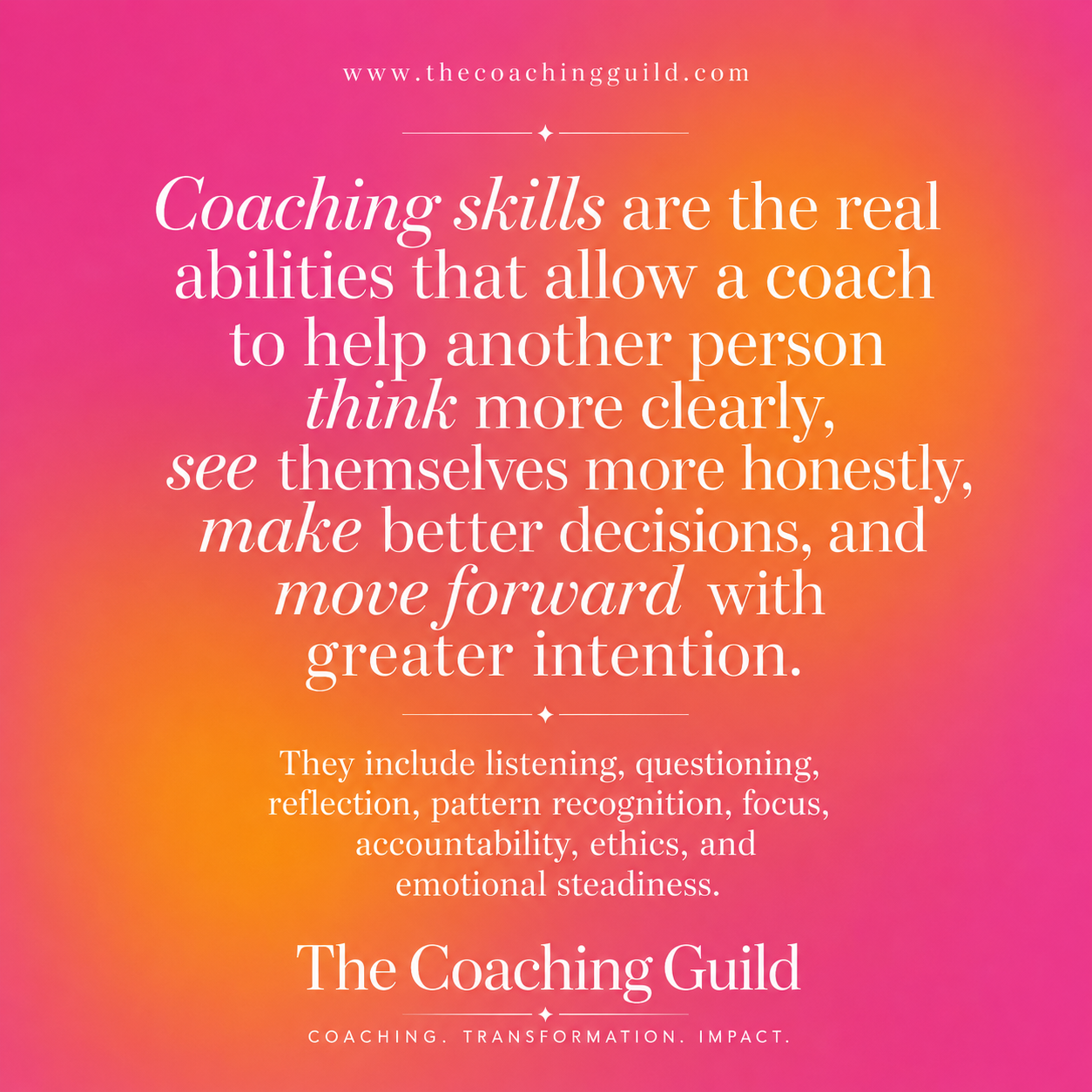
Coaching skills are the real abilities that allow a coach to help another person think more clearly, see themselves more honestly, make better decisions, and move forward with greater intention.
They include listening, questioning, reflection, pattern recognition, focus, accountability, ethics, and emotional steadiness.
Those skills can be learned.
They can be sharpened.
And they are part of what separates real coaching from performance.