What to Look for in an Ethical Coach Training Program
It is about more than meets the eye.
By: Lisa Hayes for The Coaching Guild
If you are trying to choose a coach training program right now, you are probably seeing the same words over and over again.
Transformation. Alignment. Impact. Freedom. Purpose. Success.
While some of those words may point to something real, they do not actually tell you very much about whether a program is capable of training coaches well.
That is the problem.
If you are going to invest serious time, serious money, and serious trust into learning this work, then “inspirational” is not enough. “Beautifully branded” is not enough. “I loved the founder’s energy” is not enough.
You need to know whether the training is ethical.
I do not mean ethical as a decorative value word used to make the sales page sound more responsible. I mean ethical in the deeper sense. Ethical in the structure. Ethical in the pedagogy. Ethical in the expectations. Ethical in how the program understands power, skill, client care, inclusion, and the responsibility of preparing people to work with actual human lives.
That is a much higher standard than most people are encouraged to use when shopping for coach training.
But I think it is the right one.
Coaching is intimate work. It deals in identity, decision-making, power, pain, hope, change, ambition, uncertainty, and human complexity. When people step into this field without enough training, without enough humility, without enough ethical grounding, and without enough respect for the limits of their own scope, clients are the ones who absorb the consequences.
So if you are looking for an ethical coach training program, here is what I would pay attention to.
The first thing I would look for is whether the program can clearly explain what coaching is and what coaching is not.
That sounds simple, but it is not a small question.
A lot of programs stay strategically vague here. They blur the lines between coaching, consulting, mentoring, teaching, healing, leadership, advising, and therapy-adjacent support. That vagueness can feel expansive, but it can also be a way of avoiding precision. And precision matters.
A serious program should be able to explain its understanding of coaching in plain language. It should be able to talk about scope. It should be able to talk about boundaries. It should be able to help students understand where coaching is powerful, where it is limited, and what ethical responsibility looks like in real practice.
If a training cannot define the work clearly, it is very difficult for that training to teach the work responsibly.
The second thing I would look for is whether the curriculum is built around actual skill, not just confidence or identity.
You are not paying for a new personality.
You are not paying to feel chosen.
You are not paying to be told you are already magical and therefore ready.
You are paying to learn a discipline.
That means an ethical coach training program should teach people how to listen well. How to ask questions that are useful, not performative. How to build and hold agreements. How to think with nuance. How to recognize ethical tension. How to avoid overreach. How to work with complexity without rushing to dominate it with a framework.
A strong program should make it easy to understand what students will actually learn. It should not rely only on emotional language, founder mythology, or broad promises of transformation. It should be legible as an education.
That matters because the coaching industry has become very good at selling identity. It is not always as good at teaching craft.
The third thing I would look for is practice.
Real practice.
Not just content consumption. Not just private reflection. Not just discussion. Practice.
An ethical training should prepare people to coach real human beings, which means students need opportunities to actually coach, to be observed, to receive feedback, and to improve over time. That process is part of what keeps coaching from becoming a performance art built around borrowed language.
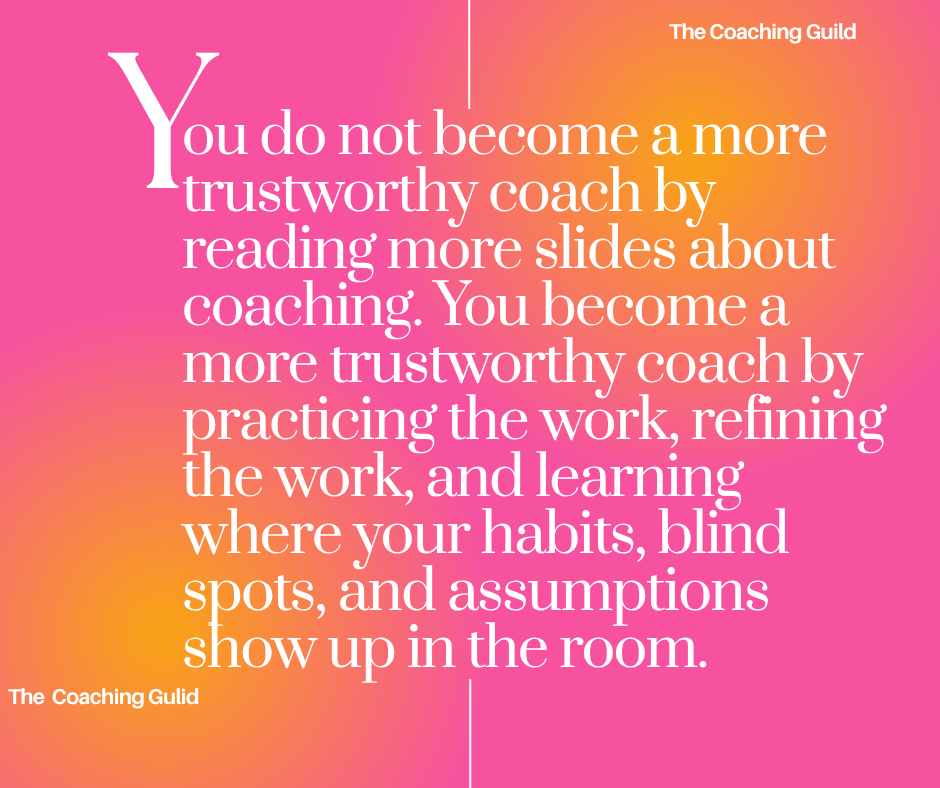
You do not become a more trustworthy coach by reading more slides about coaching. You become a more trustworthy coach by practicing the work, refining the work, and learning where your habits, blind spots, and assumptions show up in the room.
A program that takes coaching seriously should take feedback seriously too.
That brings me to the fourth thing I would look for: educational structure.
This one matters more than people think.
Many coach training programs are built almost entirely around one person’s charisma. One person’s worldview. One person’s magnetism. One person’s authority. That can feel exciting at first, but it does not always create a strong educational environment.
A more ethical program usually has more visible structure than that. It has a coherent curriculum. It has clear expectations. It has thought behind the sequence of learning. It has some level of educational design beyond personal brand force. Ideally, it also has multiple perspectives in the teaching itself.
That matters because no one person should be the entire intellectual ecosystem of a serious training.
When a program is built around one founder alone, students often absorb not just the material, but the founder’s biases, blind spots, and limitations without enough counterbalance. Multi-instructor and multi-disciplinary training is not automatically superior in every case, but it often creates more depth, more range, and more protection against personality cult dynamics masquerading as education.
The fifth thing I would look for is whether the program treats ethics as central, not supplemental.
Ethics should not be a bonus module tucked near the end.
They should not be a checklist.
They should not be a page of values language that never meaningfully shapes the training.
Ethics should run through the whole educational experience.
That includes how the program talks about clients. How it teaches power. How it handles confidentiality, boundaries, consent, scope, and accountability. How it teaches students to think about culture and difference. How it frames transformation. How it handles certainty. How it prevents overpromising. How it responds to the reality that coaching can be deeply useful and also misused.
Ethical coach training should make students more careful, not more grandiose.
It should make them more skillful, yes, but also more honest about what this work is and is not.
The sixth thing I would look for is whether diversity and inclusion are built into the institution, not pasted onto the branding.
This matters deeply because inclusion is not a side issue. It is part of whether a program understands the world well enough to prepare people to coach within it.
If a training says it values inclusion, I want to know where that value lives. Does it shape leadership? Does it shape curriculum? Does it shape examples, case studies, and assumptions about who coaching is for? Does it shape access? Does it shape how people are welcomed, seen, and supported?
An ethical coach training program should not treat inclusion like decorative morality. It should treat it like part of the standard.
The future of coaching should not be built through sameness, narrowness, or shallow representation.
The seventh thing I would look for is whether the offer is clear, honest, and financially legible.
Ethics show up here too.
A program should be able to tell you what it is, who it is for, what happens inside, what students are expected to do, what kind of outcomes it is designed to support, and what the financial structure looks like.
Clarity builds trust.
Fog erodes it.
I am always wary of offers that are emotionally persuasive but structurally vague. If a program can make you feel a lot but cannot tell you plainly how it works, that is information.
And access matters. Not because serious education has to pretend to be cheap, but because institutions make moral choices through their financial structures too. How a program thinks about pricing, flexibility, and who gets to enter the room tells you something about what it believes education is for.
Finally, I would look for whether the program seems designed to make people better at coaching, not just better at looking like coaches.
This, to me, is the question underneath all the others.
Is this training trying to prepare people for real-world coaching practice?
Or is it mostly helping them build an identity around being the kind of person who does this work?
Those are not the same thing.
An ethical coach training program should make you more grounded, more skillful, more discerning, more trustworthy, and more capable of sitting with real complexity. It should teach you to listen better, think better, and hold your role more responsibly. It should give you more respect for the work, not just more language for selling yourself.
That is what I would look for.
Not hype.
Not charisma.
Not proximity to a compelling founder.
Not an especially polished brand.
Not the fantasy of overnight transformation.
I would look for rigor.
I would look for ethics.
I would look for structure.
I would look for inclusion.
I would look for practice.
I would look for real skill development.
I would look for signs that the program understands the seriousness of preparing people to work with human lives.
Because coaching can be beautiful work.
Useful work.
Life-changing work.
But only when it is treated with the respect it deserves.
If you are the kind of person who wants to do this work well, not just enter the industry quickly, that is the standard worth using.