Real leaders repair.
Not perfectly. Not theatrically. Not with a long speech about how hard leadership is. But directly.
If harm happens in your business, your client work, your marketing, your relationships, or your community, the answer is not to spin it. It is not to disappear. It is not to punish people for noticing. And it is definitely not to blame the people who were affected for having a reaction.
The answer is repair.
That does not mean you can undo every impact. It does not mean every situation ends neatly. It does not mean everyone will stay. But it does mean something very simple and very rare:
You tell the truth.
You take responsibility for your part.
You make the correction you can make.
And you let your leadership be measured by what you do next.
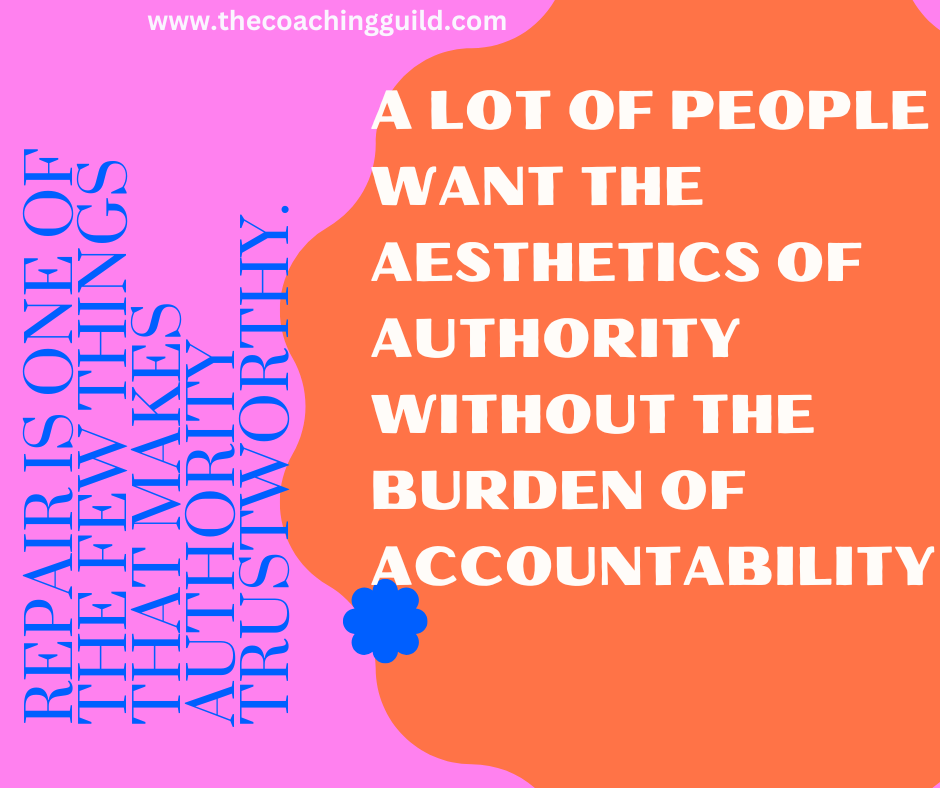
A lot of people want the aesthetics of authority without the burden of accountability.
They want to be seen as leaders. They want trust, access, deference, influence, and credibility. But the minute something lands wrong, causes harm, breaks trust, or exposes a blind spot, they reach for the usual moves:
deflection
silence
rebranding
minimizing
counterattack
or the old favorite, acting like the real problem is that someone noticed
That is not leadership.
That is brand management in a panic.
Real leadership is not proven by whether you avoid mistakes. It is proven by whether you can stay present when repair is required.
Can you face what happened without immediately trying to protect your image?
Can you hear impact without collapsing into performance?
Can you own your part without turning accountability into self-flagellation?
Can you make a change that costs you something, instead of offering language that costs you nothing?
That is the work.
Repair is not weakness.
Repair is not humiliation.
Repair is not losing authority.
In fact, repair is one of the few things that makes authority trustworthy.
Because anyone can look powerful when things are smooth. Anyone can sound wise when no one is challenging them. Anyone can appear “in integrity” when nothing is being asked of them.
But when there is friction, rupture, disappointment, or harm, that is where the standard shows.
The standard is repair.