What Is Trauma-Informed Coaching? What It Is, What It Isn’t, and Why It Matters
It is way more than just a catchy marketing phrase.
By: Lisa M. Hayes for The Coaching Guild
If you have spent any time around modern coaching spaces, you have probably heard the phrase trauma-informed coaching.
It is one of those terms people use often and define poorly.
Trauma-informed coaching should not be a trend word, a branding move, or a vague promise of emotional depth. It should mean something real.
A useful place to start is this: a trauma-informed approach recognizes that trauma is common, that it can affect how people think, feel, relate, decide, and respond, and that support settings should be designed in ways that increase safety, trust, choice, and the likelihood of not retraumatizing people. SAMHSA describes trauma-informed care in nearly those exact terms, emphasizing recognition, response, and active resistance to retraumatization.
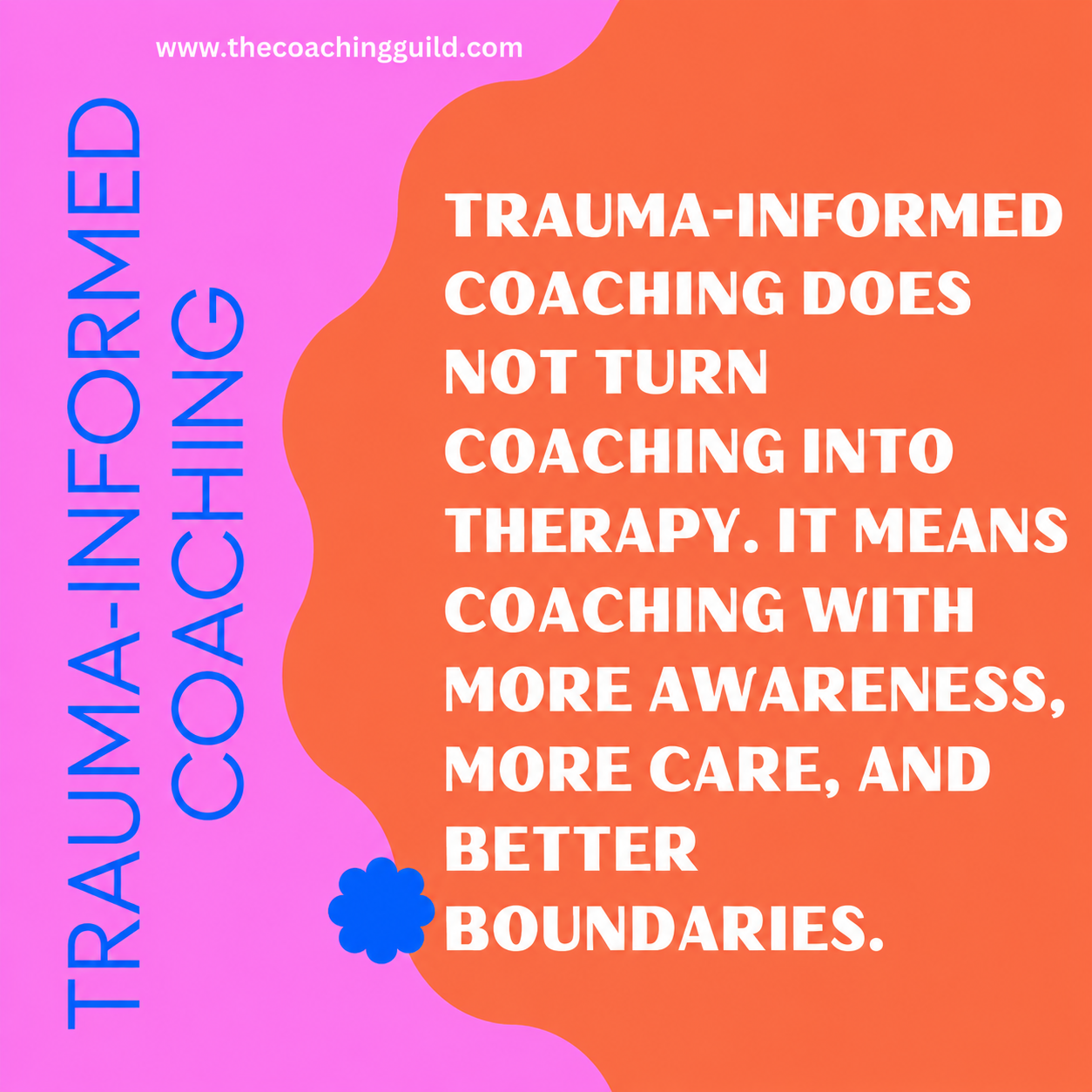
In coaching, that does not mean turning coaching into therapy. It means coaching with more awareness, more care, and better boundaries.
What trauma-informed coaching means
Trauma-informed coaching means the coach understands that many clients have been shaped by adverse experiences, whether or not those experiences are named directly in the room.
SAMHSA defines trauma as an event, series of events, or set of circumstances experienced as physically or emotionally harmful or threatening that can have lasting negative effects on mental, physical, social, emotional, or spiritual well-being. It also notes that trauma-informed environments are built around realizing trauma’s impact, recognizing signs and symptoms, responding appropriately, and resisting retraumatization.
Put simply, trauma-informed coaching does not assume every client is traumatized in a clinical sense, but it does assume that human beings come with histories, nervous systems, protective strategies, and lived realities that matter.
That changes the way a coach listens.
That changes the way a coach structures safety.
That changes the way a coach understands resistance, overwhelm, shutdown, hypervigilance, urgency, people-pleasing, and fear.
Trauma-informed coaching is not therapy
This is one of the most important distinctions.
Trauma-informed coaching is not trauma therapy. It is not diagnosis. It is not clinical treatment. It is not a coach wandering outside scope with a softer voice and deeper vocabulary.
A trauma-informed coach may work with care around activation, agency, boundaries, pacing, and choice. A trauma-informed coach may recognize when trauma dynamics could be shaping the client’s experience. A trauma-informed coach may know how to create a safer and more empowering process.
That still does not make coaching therapy.
The point is not to blur the line. The point is to coach responsibly inside it.
Why trauma awareness matters in coaching
Trauma affects people’s bodies, behavior, relationships, attention, emotions, and sense of safety. SAMHSA says trauma can negatively affect functioning across mental, physical, social, emotional, and spiritual well-being. The University of Denver’s Butler Institute similarly describes trauma-informed coaching as a way of understanding past trauma, its current effects, and the role resilience can play in client growth.
That means a coach who has no trauma awareness at all may misread what is happening in the room.
They may read shutdown as laziness.
They may read inconsistency as lack of commitment.
They may read hyper-independence as confidence.
They may read people-pleasing as agreement.
They may push for action when the client actually needs more safety, more pacing, or more choice.
Trauma-informed coaching does not remove rigor. It improves precision.
What trauma-informed coaching should include
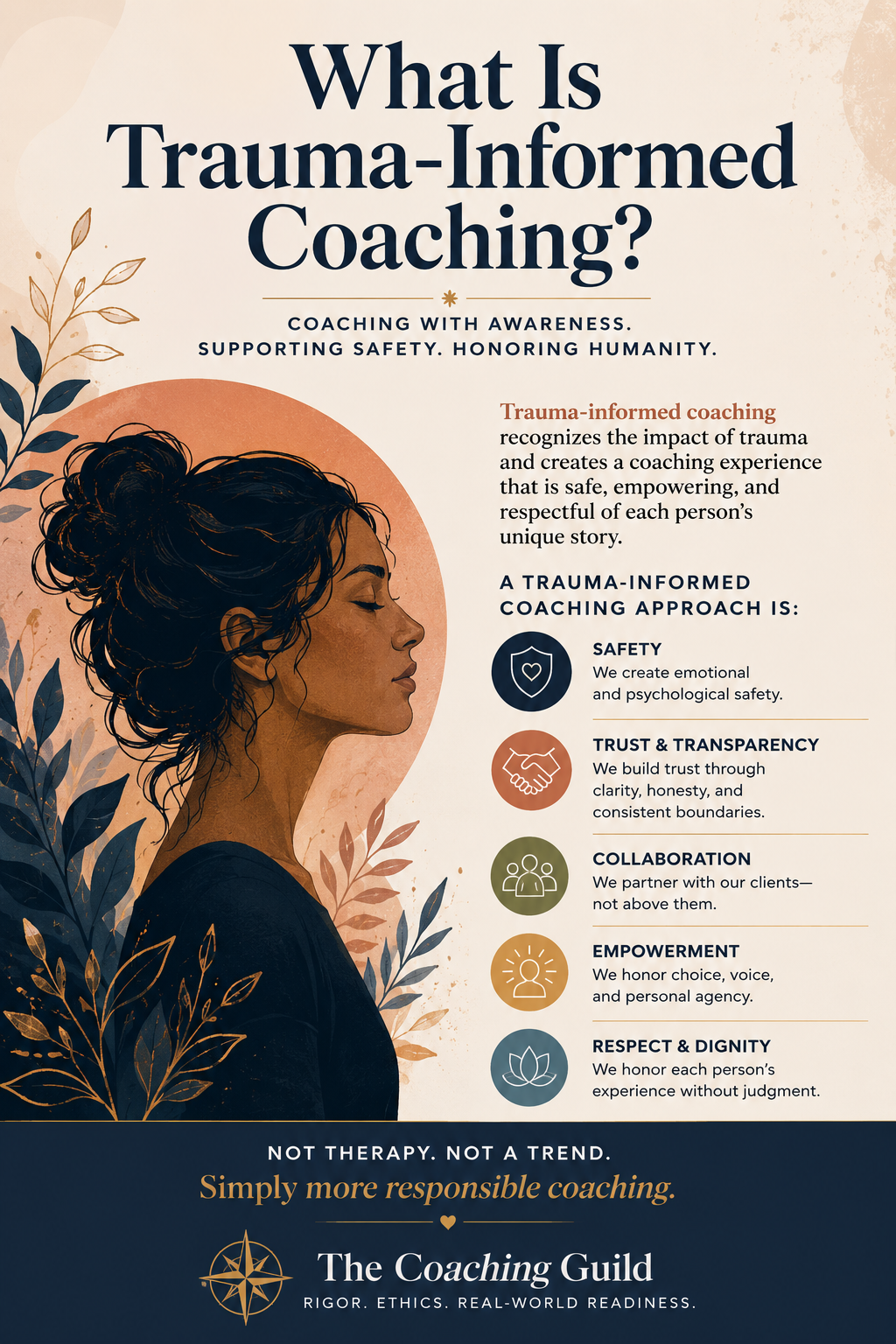
A trauma-informed coaching approach should include attention to safety, trust, collaboration, empowerment, and choice. Those are not invented coaching buzzwords. They are consistent with SAMHSA’s current trauma-informed principles, including safety, trustworthiness and transparency, collaboration and mutuality, and empowerment, voice, and choice.
In practice, that can look like:
clear agreements and expectations
respect for pacing
careful attention to power dynamics
more choice in how the process unfolds
less coercive or performative accountability
awareness of activation and overwhelm
respect for the client’s agency and lived reality
It also means the coach does not treat intensity as proof of good work.
What trauma-informed coaching does not mean
Trauma-informed coaching does not mean the coach becomes artificially gentle, vague, or afraid to challenge.
It does not mean lowering standards.
It does not mean avoiding truth.
It does not mean coaching people as though they are fragile.
It means challenge is offered with discernment.
It means accountability is not weaponized.
It means the coach is not reckless with power.
It means the process is designed to support growth without unnecessary harm.
A coach can be both trauma-informed and clear.
A coach can be both trauma-aware and rigorous.
In fact, that combination is often what makes the work stronger.
Why this matters in coach training
Future coaches need more than good intentions.
If trauma is as widespread as public health and behavioral health sources suggest, then coach training should prepare people to work with that reality rather than pretending all clients arrive as emotionally uncomplicated blank slates. SAMHSA’s current guidance explicitly frames trauma-informed work as a systems and practice issue, not a niche concern.
That is one reason this topic matters so much in training.
A serious coach training program should help students understand:
how trauma can affect behavior and decision-making
how to create safer coaching containers
how to recognize when pacing matters
how to avoid retraumatizing dynamics
how to respect scope
how to refer when the work calls for something beyond coaching
Without that, coaches are more likely to confuse force with transformation.
Where The Coaching Guild stands
At The Coaching Guild, trauma-informed coaching is part of the actual teaching ecosystem, not just a borrowed phrase. Your faculty page includes “Trauma Informed Coaching in the Real World,” and your public positioning consistently emphasizes rigor, ethics, and real-world preparation.
That matters because trauma-informed coaching should not be decorative. It should be part of how a serious school thinks about human complexity, coaching ethics, and the lived reality of clients.
A coach does not become more effective by ignoring trauma.
A coach becomes more effective by learning how to coach human beings as they actually are.
Final answer
Trauma-informed coaching means coaching with a real understanding that trauma is common, that it can shape how people respond, and that coaching should be structured in ways that support safety, trust, agency, and growth without unnecessary harm. SAMHSA’s current trauma-informed framework supports exactly that kind of emphasis on recognition, response, and resisting retraumatization.
It is not therapy.
It is not a marketing flourish.
It is not softness for the sake of softness.
Done well, it is simply more responsible coaching.